
TV Review: 'What is Starfleet?'
It's The Documentary Episode on 'Strange New Worlds'

Babylon 5 did it. Battlestar Galactica did it. M*A*S*H and ER both did it a couple of times. A Star Trek fan film called Axanar — or, at least, a 20-minute teaser for a proposed fan film of that title — did it, too. But this is the first time an official Star Trek series has done an episode that is presented in documentary format.
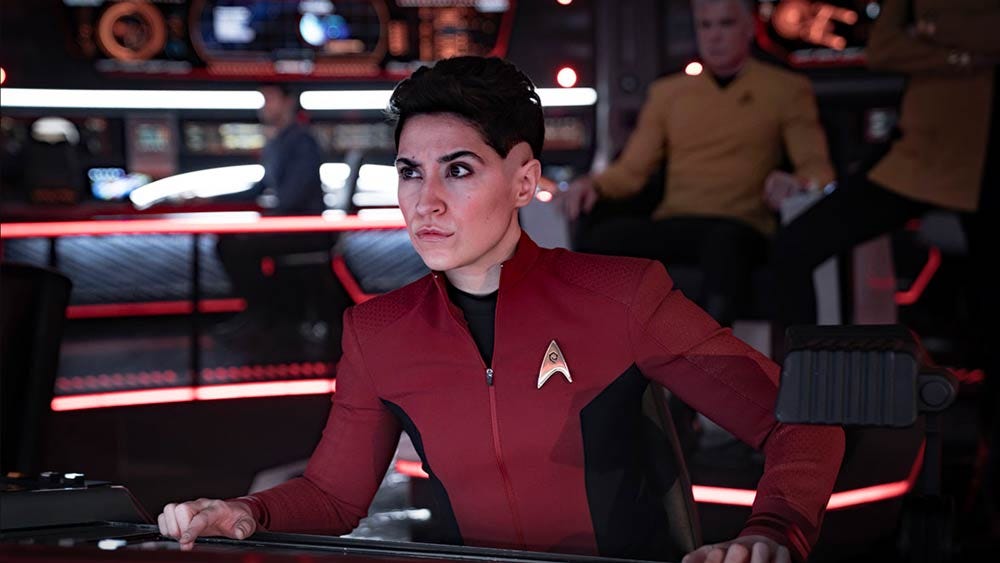
We’ve known it was coming, of course, ever since Ortagas’ younger brother, Beto (recurring guest star Mynor Luken) — the documentary filmmaker supposedly behind this week’s episode — boarded the Starship Enterprise earlier this season. Various aliens, with various degrees of sincerity or bad faith, have accused ships called Enterprise of being warships sent in the name of peace but with hostile intentions. But this is an interrogation of a different order: With “What is Starfleet?” Beto challenges Starfleet itself, and the Federation with it, asking uncomfortable questions that should resonate in our own ears: What makes Starfleet a virtuous organization rather than just another military in service of an imperial power? For that matter, how is the Federation substantially different from an empire?
(Photo: Paramount+)
These are questions that have only rarely come up in the 61-year history of the franchise, the scoffing of skeptical aliens notwithstanding. Deep Space Nine made this point in its Maquis storyline, most notably with the accusations flung by turncoat officer Eddington. (“You know, in some ways you're even worse than the Borg,” Eddington stormed at Sisko once he was unmasked; “At least they tell you about their plans for assimilation!”) Elsewhere, the Klingons behind the war that launched Discovery were specific about their fears in Federation domination, as they were decades later (according to the in-universe calendar, that is) both in Star Trek III: The Search for Spock and, more pointedly, Star Trek VI: The Undiscovered Country. As the sun sets on an American Empire that never quite was, it might be time to use the Star Trek mirror once more to ask ourselves whether America stands for universal freedom and equality before the law for everyone, or if those sentiments are mere wallpaper covering over the ugly work of nation-building. Are we truly the good guys? And are our sci-fi stand-ins, our 23rd century heroes, truly good guys, too?
Beto seems skeptical at first, and his cameras record a mission that seems inherently dubious as Enterprise ferries “cargo” to war-torn Lutana VII, a planet under siege by a “sister world” called Kasar. As part of its delivery, Enterprise prepares to escort a Jikaru, a mammoth life form, from the oceans of a far-flung world called Tychus B. Expecting to take the Jikaru (which is somewhat dubiously catalogued as “livestock”) under two and in through space to Lutana, Pike and his crew come to realize that the enormous creature can propel itself… and protect itself. The Jikaru is powerful enough to disable starships; as a weapon, the creature could turn the tide of a war that, as lightly sketched as it is, bears more than a passing resemblance to the conflict between aggressor nation Russia and its democratic neighbor, Ukraine, as well as to other geopolitical tragedies unfolding in real life. (We learn early on of the lopsided nature of the conflict, with aggressor world Kasar suffering only 119,000 casualties and inflicting a massive death toll of nine million on the Lutani.)
The Lutanis’ need for help is self-evident, even if they aren’t part of the Federation (and even if, as Ortegas notes tartly, they have been known to be cozy with the Klingons). But by interjecting itself in the conflict, is Starfleet preserving a balance of power and preventing even greater chaos? Or is it putting its thumb, in the form of a heavy cruiser, on the scale of galactic geopolitics? Moreover, is it right to abduct a creature from another planet and press it into service in a war? It’s a question worth asking any time a living creature is used for someone else’s designs, but the ethics of the situation grow infinitely more sticky when Spock telepathically senses that the Jikaru is smart and self-aware.
(Photo: Paramount+)
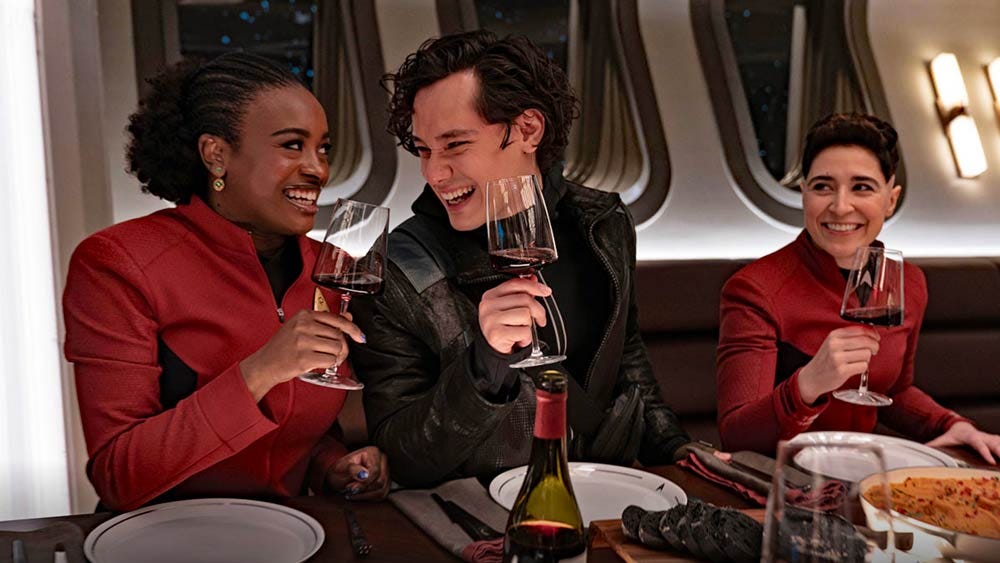
The episode feels a little bare-bones, narratively speaking, in part because the documentary leaves some things out due to their being classified. Whether the script never quite gelled, or whether writers Kathryn Lyn & Alan B. McElroy simply decided to lean into sketchy nature of the mission itself and give us an incomplete understanding of the overall situation — just who are the Kasar? What other alliances do the Lutani have? — the political and tactical context of the episode never quite becomes clear-cut. But then, Beto’s documentary itself strays somewhat from the moral dilemmas at hand when Uhura, who intuits that the creature is trying to communicate, grows angry at Beto for treating their romantic relationship as fodder for his film. What’s more, director Sharon Lewis brings a true documentary feel to the episode: It’s not just talking heads, it’s cleverly placed security camera footage and the not-quite-invisible presence of an observer taking video even when he shouldn’t that helps give the episode visceral impact over and above its dilemmas.
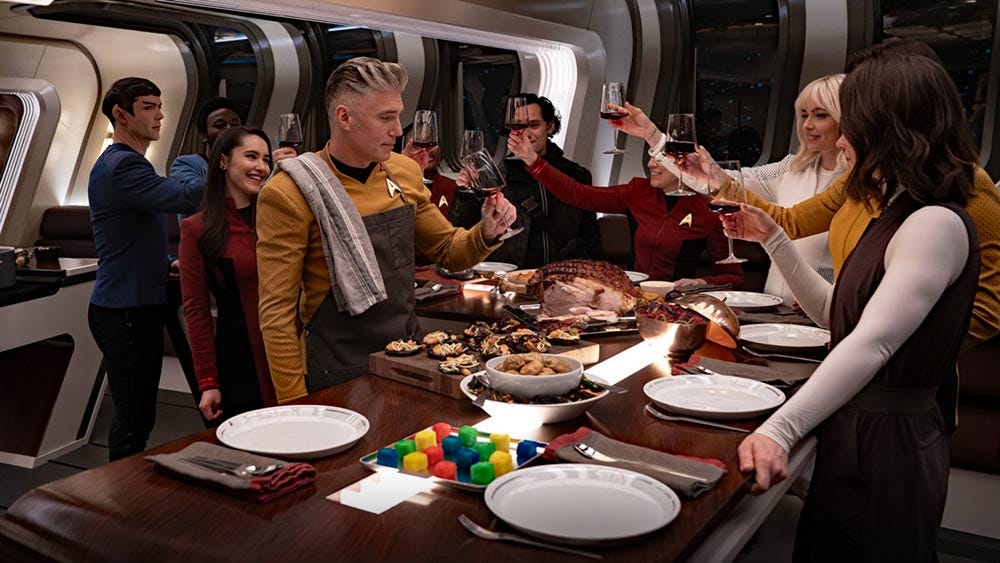
Strange New Worlds is no Deep Space Nine, and while it has explored tough choices before and even allowed one of its characters to get away with murder — literally — it’s not going to tarnish our beloved Starfleet too badly. Beto’s film agonizes, but when it wraps up with a cozy montage showing one of the captain’s dinner parties it leaves the viewer with a feeling that harder questions… and harder answers… are still right there, waiting to be mined. It’s a comfort, in challenging times, to remember Star Trek’s place in the culture; it’s been a somewhat erratic mythos, but it’s also been a (more or less) constant moral compass. We need heroes, and we need to see them stand for something even when their foundational principles create internal conflicts. This time we see Pike, Number One, and others of the crew struggle to reconcile duty with ethics, and that’s the sort of storytelling in which Star Trek always shines.
It’s good to see Strange New Worlds is leaning into the moral problems that make the franchise compelling; we can hope some of the dilemmas and doubts presented here are revisited before the show ends with its truncated fifth season.
(Photo: Paramount+)