
Interview: World-Best Gelato Maker Sergio Dondoli Serves Up a 'Happy Life'
The maestro offers his insights from his famed gelateria in Tuscany.

When Sergio Dondali opened his world-famous Gelateria Dondoli in the Tuscan town of San Gimignano in the 1980s, he faced bureaucratic inertia as well as resistance from the other gelaterias in town. He overcame those obstacles and went on to forge a working relationship with a bio-farm, from which he began sourcing top-quality milk. He also began to find organically grown fruits and herbs to use in his creative recipes — and it’s the artistry of those recipes, with their delightful flavor combinations, as much as his skill in creating gelato, that’s led to Gelateria Dondoli winning the Ice Cream World Championship twice, not to mention a trunk’s worth of other prestigious awards.
Italian born but educated in the art of gelato in Germany, Sergio is something of a citizen of the world. “I speak French, German, a little bit English, a little bit of Spanish,” he says during the course of our conversation, which is conducted in English. “And Dutch, I can understand,” he adds.
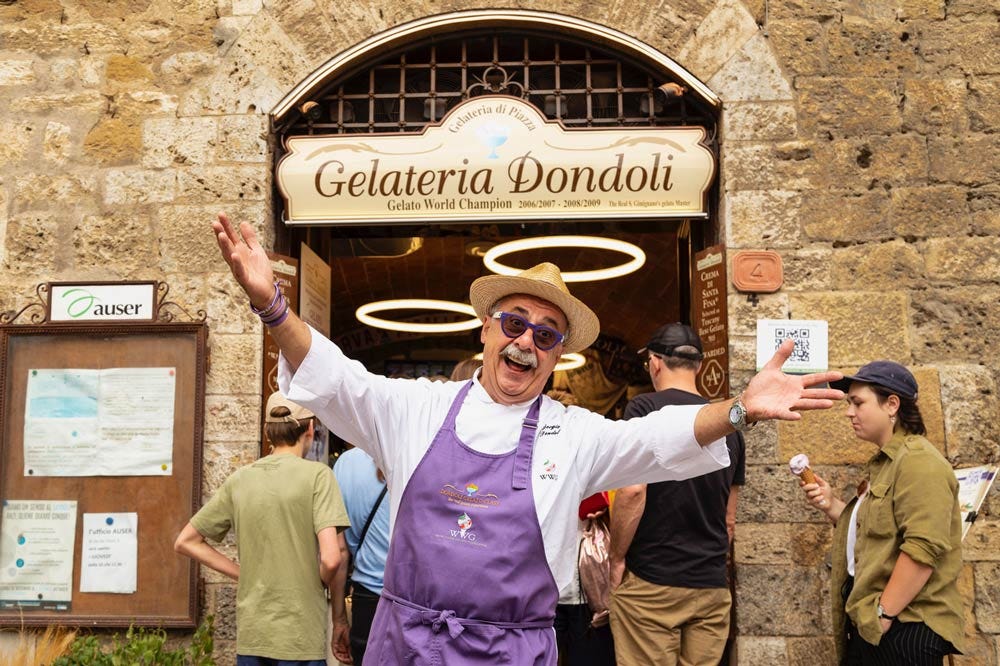
(Sergio Dondoli. Photo courtesy of Happy Life the Movie, LLC)
Over a Zoom call, Dondoli is the same magnetic presence, with the same exuberance, ready laugh, and raconteur’s storytelling relish, as he is in filmmaker Jay Arnold’s documentary Sergio Dondoli’s Happy Life. The title carries a double meaning: Gelato, as Dondoli explains in our chat, brings people happiness. (No quarrel there.) But also, as the film posits and Dondoli reiterates to me, there’s a happiness that comes across in the ingredients themselves — especially the milk, which is the product of cows that are allowed to live their lives in a cruelty-free manner. Dondoli notes in the film that while gelato is not health food, the way he sources his ingredients and makes his product offers the consumer minerals, proteins, and vitamins that they wouldn’t get from less meticulously sourced and crafted fare.
Gelato isn’t just the Italian word for “ice cream.” It’s a different creation altogether. Ice cream typically involves ingredients gelato does not, including egg yolks, more cream, and the deliberate inclusion of air bubbles to give it a lighter texture. Gelato, on the other hand, primarily relies on milk and uses less cream; it’s also churned more slowly in order to incorporate less air, which results in a denser texture.
Less air also results in a fuller flavor, and that’s a benefit when you’ve contemplating favorites like Sergio’s “Rosemary Baby” flavor — a pairing of rosemary and raspberry — or his “Champelmo,” an award-winning sorbet that combines pink grapefruit and sparkling wine. Another viniculture-inspired flavor is his “Vernaccia Sorbet,” based on the grape varietal of the same name. Then there’s “Amadei Chocolate,” a tempter that, as the shop’s website notes ( https://www.gelateriadondoli.com/english/specialties-gelateria-dondoli.html ), “has won the Oscar for the best chocolate in the world for as many as 4 years running (from 2005 to 2009).”
A genuine gelato maestro — almost by definition, given the inclusion of Gelateria Dondoli in Gelaterie d'Italia ( https://www.gamberorosso.it/guide/gelaterie-ditalia/ ), the Gambero Rosso ( https://www.gamberorossointernational.com/ ) guide to gelaterias in Italy, which awards a maximum ranking of three ice cream cones to the very best of the best gelaterias — Sergio isn’t just the creator of frozen gourmet goodness; he’s also a teacher, leading 90-minute gelato classes ( https://www.dondoligelatoclass.com/gelato-class/ ) in which participants use the same top-shelf ingredients as the maestro himself and learn to make gelato under his tutelage.
It's all too delicious to pass up!
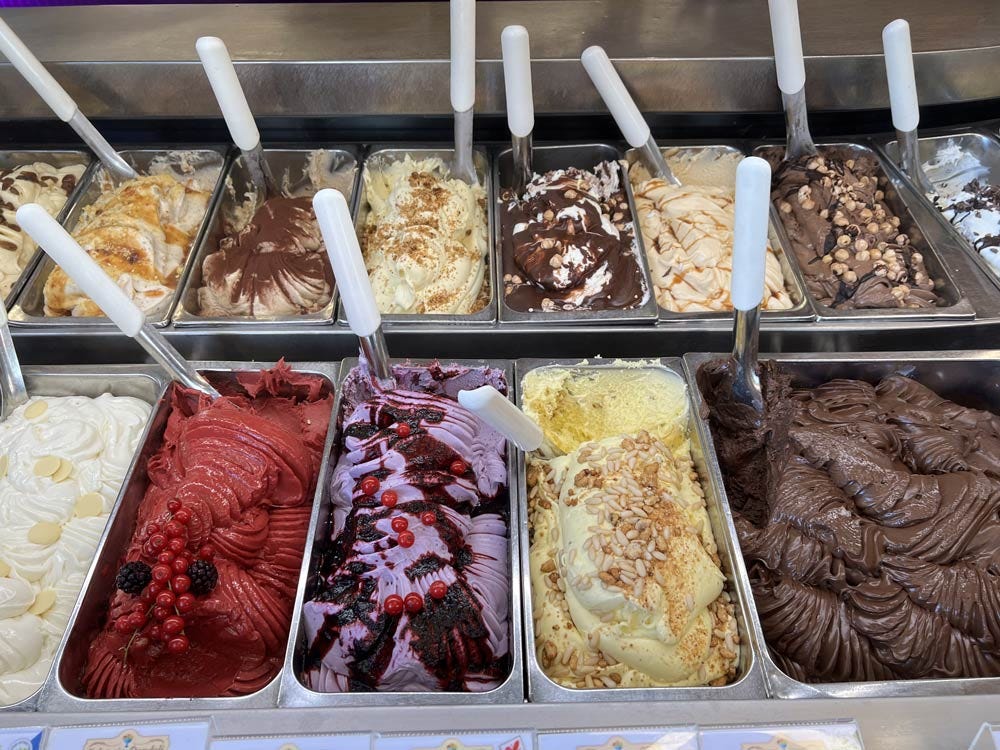
(Photo courtesy of Happy Life the Movie, LLC)
Kilian Melloy: How did you end up doing this documentary? Did Jay Arnold contact you and approach you about it?
Sergio Dondoli: No, it was much more easy. Right now, when I talk with you, I am in my gelato academy here in San Gimignano. Many people come to the gelato academy just to have the gelato experience. At some places, they make pasta or pizza, whatever, but gelato the experience, [as far as] I know, is the only place in Italy where you come here, you learn about the ingredients, you clean the fruit, and you make the gelato, so you understand the gelato.
I remember in July of 2023 a group eight or nine people came and they made this experience. When the class was finished, Jay came to me and said, “May I have the honor to film your story?” I said yes. What could I say? And so it began. We wrote each other a couple times just to organize everything, and then he came with some people in October 2023, and we filmed this in a week.
Kilian Melloy: Has gelato always been part of the acclaimed cuisine of Tuscany, or has it only been recently that it’s taken more seriously?
Sergio Dondoli: When we consider the history of gelato, we have to say that the gelato of today was born in Tuscany in the 1500s. So, what can I tell you more?
Kilian Melloy: Was there always artisanal gelato, or is that more recent than the 1500s?
Sergio Dondoli: When I came to San Gimignano, the gelato shops that existed before me were not really artisanal. They mixed the products together and they called it gelato. Real artisanal gelato, like mine, was something new. At that time, everyone wished to have pistachio [flavor], but it had to be green. The pistachio [I sold] was green-gray. It was a shock! People would tell me, “I ordered pistachio, not hazelnut.” It was a fight for several years to let people understand. One day my wife said, “If you don't stop making this [non-green] pistachio, you can do this alone, because I can’t have this fight every day with everyone.” But this let people know that there’s a different kind of gelato.
Kilian Melloy: And now your gelato is world-famous.
Sergio Dondoli: We began to work with natural and local ingredients, and this was the reason for “Happy Life.” If you know the story about my cows… I can cry now when I'm thinking about this moment. It's always emotional for me when I talk about this, because I was lucky. In life, you need a lot of luck. How would my life have been if I didn't meet this guy that had this wonderful farm, and who made this wonderful milk? He respects the cows. And then I began to use raw milk. I mean, I really was the first Italian to use raw milk, not pasteurized. [Note: Gelateria Dondoli pasteurizes the milk on-site as part of the gelato-making process.] Then we began to use fresh organic fruit when it's possible, and this made all this difference for our gelateria.
San Gimignano is [a major tourist destination] for many people, very important people, and they made the difference. They make publicity for you, and this began to make my gelateria popular all over the world. Everyone makes publicity for you when you make a good product and they are happy, because they come home and say, “I had the most wonderful gelato there.” That’s publicity! And this began to make my gelateria popular all over the world.
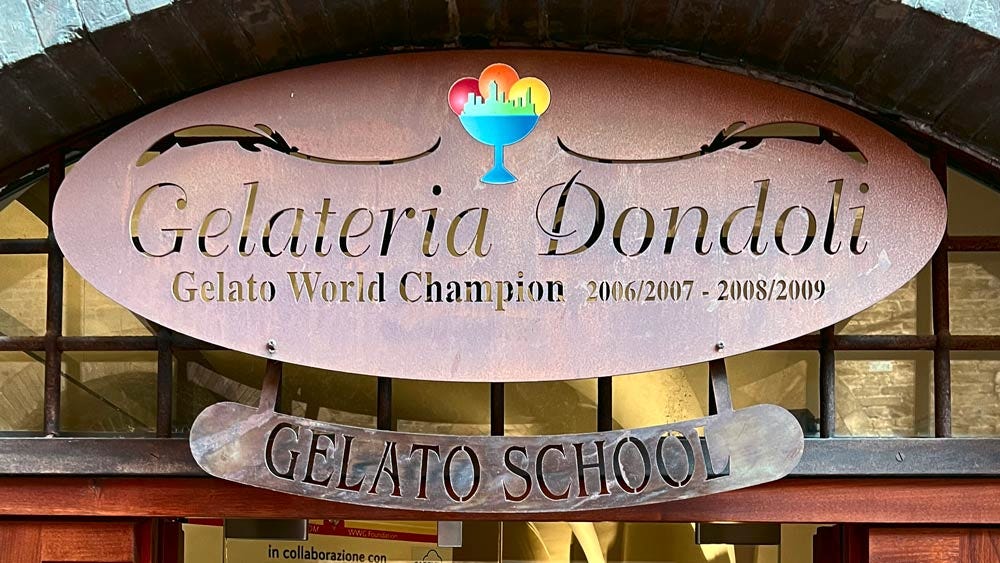
(Photo courtesy of Happy Life the Movie, LLC)
Kilian Melloy: But the essential thing is the gelato, and you have a talent as an artist in the way you put ingredients together, like with your famous “Rosemary’s Baby” flavor, or the lavender and blackberry, or the champagne flavor.
Sergio Dondoli: You know these flavors came [about] because I began to work with the ingredients from around my area. In Tuscany you find rosemary on every street corner, so I had this smell in my brain from when I was a child. So, I tried to combine rosemary with something, and the best combination was with raspberry. It’s the same story with blackberry and lavender — the lavender is everywhere, you find lavender in every garden. You have to be curious, and even crazy.
Kilian Melloy: Did you come up with flavors that were so crazy they didn’t work?
Sergio Dondoli: Yes. One example was hazelnut and truffle. It's an incredible combination because, you know, the best truffle comes from under the hazelnut trees. For me, that was a good combination, and I put it on the [menu] until people began to say, “I don't like truffle. Come on! Why would you present this?” They didn't expect this. They said, “Oh, no, you cannot combine these flavors.” I don't know; they put lemon and tiramisu together — my god, you cannot combine those! It doesn’t work! They say, “The lemons are good, the tiramisu is good.” It's true; they are both good, but the combination is terrible!
Kilian Melloy: I was fascinated by the inventiveness of your entrepreneurial methods. For example, when you first opened Gelateria Dondoli they began to do street work in front of your shop, and so nobody came inside. So you went to the tour busses to greet everyone in their own language — French, Spanish, whatever — and say, “Come to my gelateria!” This was brilliant marketing.
Sergio Dondoli: You know, the brilliant ideas come to you when you are in big difficulty. I cannot tell you how they come, but I was in such financial difficulty, you cannot image. I had to invent something. This was the biggest marketing process I could make [at the time], and this let me survive that year. And believe me, some clients from that time, from the tourist agency, they still come even now after 33 years. Incredible!
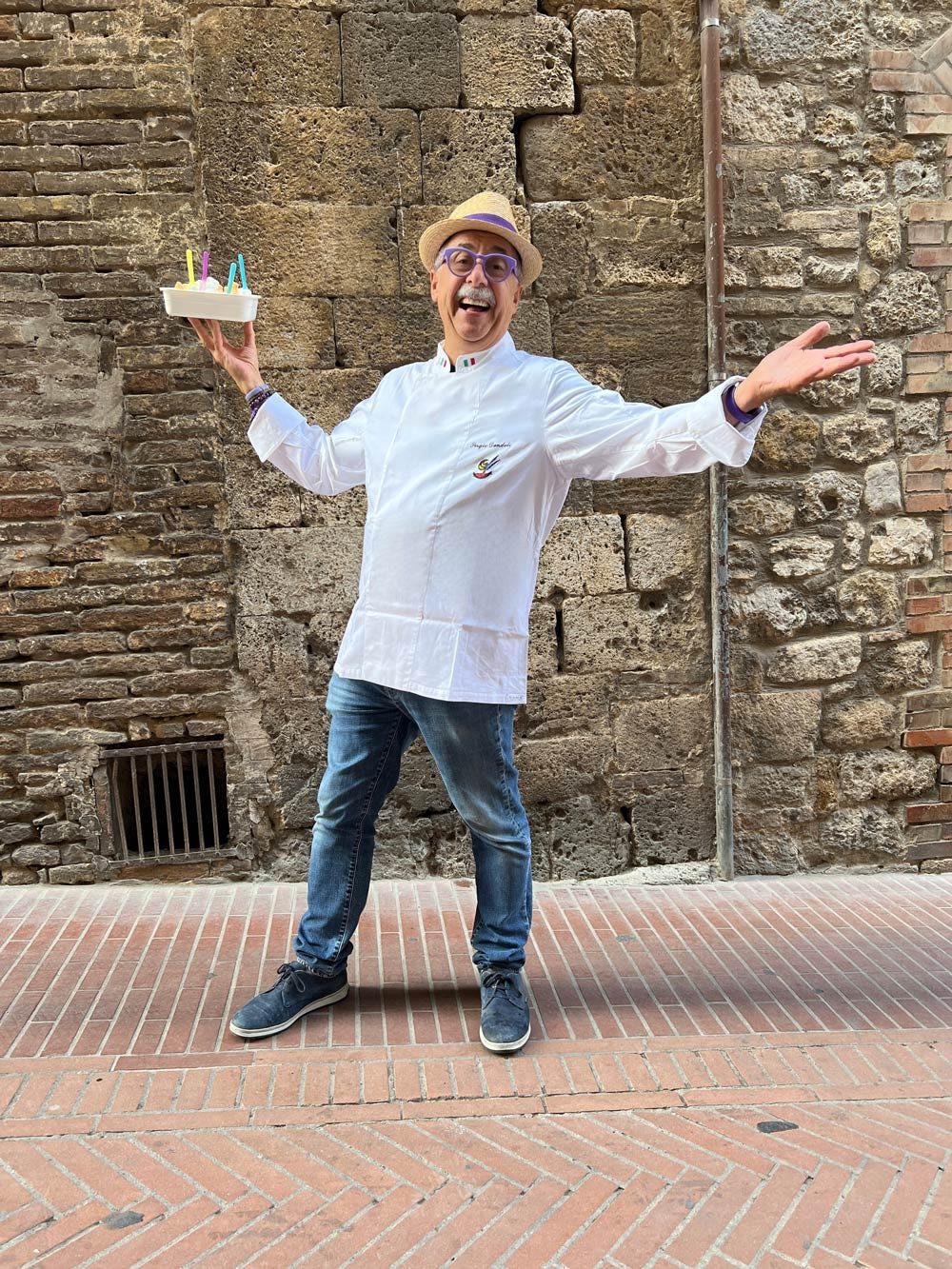
(Photo courtesy of Happy Life the Movie, LLC)
Kilian Melloy: In America you see people on the street with a hamburger in their hand, or they are eating a hot dog, or they have walk around with coffee in paper cups. You don't see that here. The one thing you see people eating on the street is gelato. Why is gelato so unique in this way?
Sergio Dondoli: Gelato represents a pleasure, much more than a hamburger, much more than Coca Cola, much more than coffee. When I began to make gelato, I was living in Germany, and the people who taught me to make gelato — they had a gelato shop since probably 50 years — they told me, “Sergio, you will realize that when people have a crisis, they lost a job or something like that, you will work much more because gelato represents something happy! Happy moments for cheap money. People going to buy more gelato because they need to have some happiness, because they are sad.” This is one difference between [a cup of coffee or a hamburger] and gelato in the hand [when walking on the street], because gelato represents happiness.
Kilian Melloy: There’s a gelateria in Bolzano called Avalon, and they make a gelato that tastes exactly like the flavor it says it is. If it says orange, it tastes exactly like an orange. If the flavor is called lemon, it tastes exactly like a lemon. If it says strawberry, it tastes exactly like a strawberry. It’s really gourmet — and the owner is self-taught.
Sergio Dondoli: Have you had the guide? [Shows his copy of Gelaterie d'Italia.] Let me check. Yes, right — Avalon! Two cones! But in that area is no one with three cones. [Note: In the guide’s 2025 edition, only 73 locations are awarded the three-cone highest ranking.]
Kilian Melloy: Really? Avalon only gets two cones?
Sergio Dondoli: But don't worry: When someone is inside [the guide], that’s a real gelato maker.
Kilian Melloy: Do you have three cones in the guide’s ranking?
Sergio Dondoli: We had three cones since the first year. Now is the year number nine we have this guide. We hope can preserve this [ranking], because every time we go there to receive this honor, and I was forced to tell Gambero Rosso and the 100 people there, I said, “You know, for seven years I always got this prize, [the rating of] three cones. But you have to know that this eighth year, I don't produce the gelato myself anymore. My son does that. So next time, please give him the prize, because I don't produce no more. I do different things.”
Kilian Melloy: When I return to Tuscany next time, I will definitely come to San Gimignano to Gelateria Dondoli.
Sergio Dondoli: And take time to do the gelato class!
For more about Gelateria Dondoli, visit the website: https://www.gelateriadondoli.com/home-uk.html Sergio Dondoli’s Happy Life streams on digital platforms starting August 19.