
Interview with Paul Oremland: The Mysteries of 'Mysterious Ways'
The New Zealand director discusses faith, filmmaking, and the surprises that came with making a movie about a subject that's still taboo for many in the Pacific community.

New Zealand director Paul Oremland has brought us queer romance/coming of age movies like As It Is, in which a gay boxer falls in love and has a fight of a different kind on his hands, or the thriller Surveillance 24/7, which involves a gay hookup, a murder, and a scandal that could bring down powerful people. He’s also put himself in front of the camera, exploring his sexual past with the documentary 100 Men, in which he looks up — yes, one hundred! — guys he’s hooked up with throughout his life to see where they are now and what they are doing (and to get to know them better than he ”knew” them back then).
Oremland’s most recent feature, 2023’s Mysterious Ways, blends today’s culture wars with the ancient mysteries of faith, love, and divine destiny. Anglican priest Peter (Richard Short) is a fierce champion of justice, always willing to advocate for the oppressed, so when he finds his own plans to marry his Samoan partner Jason (Nick Afoa) have come under attack by his bishop, his congregants, and the headline-hungry media, he’s ready and willing to push back. Indeed, he may be a little too eager for a scrap for Jason, who doesn’t like being in the spotlight, especially when it draws attention to his checkered past and throws his job as the director of a youth recreation center into doubt.
Complicating matters is the arrival of Jason’s nephew, Billy (Joe Malu Folau — no relation to the infamously anti-gay Australian athlete, Oremland assures me in our interview), an aspiring social media influencer whose seemingly non-traditional gender presentation is deeply rooted in traditional Samoan culture. (The film clues us in on how, prior to Christian missionaries, Samoans honored and cherished faʻafafine, people who transcend the gender binary.)
A multi-faceted, compassionate film, Mysterious Ways was made on a shoestring, but it will tug at the strings of viewers’ hearts.
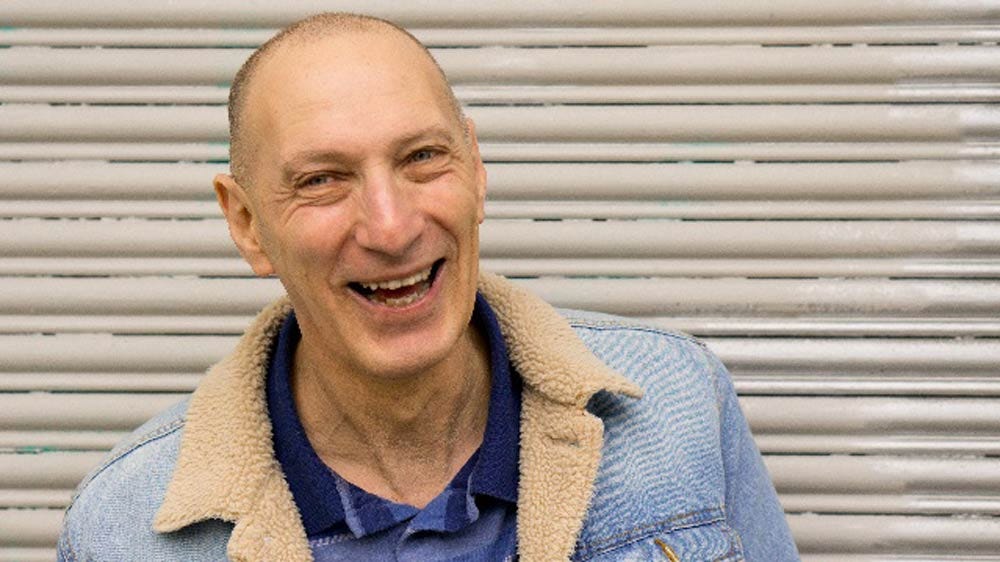
(Paul Oremand. Photo provided.)
Kilian Melloy: What a pleasure to be talking today with the director of 100 Men, as well as so many other movies that we've enjoyed.
Paul Oremland: Thank you. Some of my earlier works are probably better known — perhaps not in the States. 100 Men was an interesting film to work on; to be perfectly honest with you, I'm quite shy, and when the New Zealand Film Commission said they were interested in doing this, they made a condition that [I had to appear in it]. Initially, I wasn't going to be in the film, and they said it wouldn't work that way. I mean, they were right. But they said they would only commission this if I agreed to front this and own it, which was quite hard because I don't like being in front of the camera. I don't even like to be photographed.
Kilian Melloy: What made Mysterious Ways the story you wanted to film at this point?
Paul Oremland: I always wanted to do a love story. The story grew from there in terms of setting it in the Pacific backdrop, which is peculiar to New Zealand to some extent, but it's certainly where that struggle is very large. I constantly meet young gay men who continue to struggle with this. And I don't see why gay people shouldn't be allowed faith. I grew up in a Christian fundamentalist household, but I'm not religious anymore. I call myself a spiritual atheist, if such a thing exists; there's a line in the film, “We don't want to be second class Christians.” I really feel passionate about that. Faith is important.
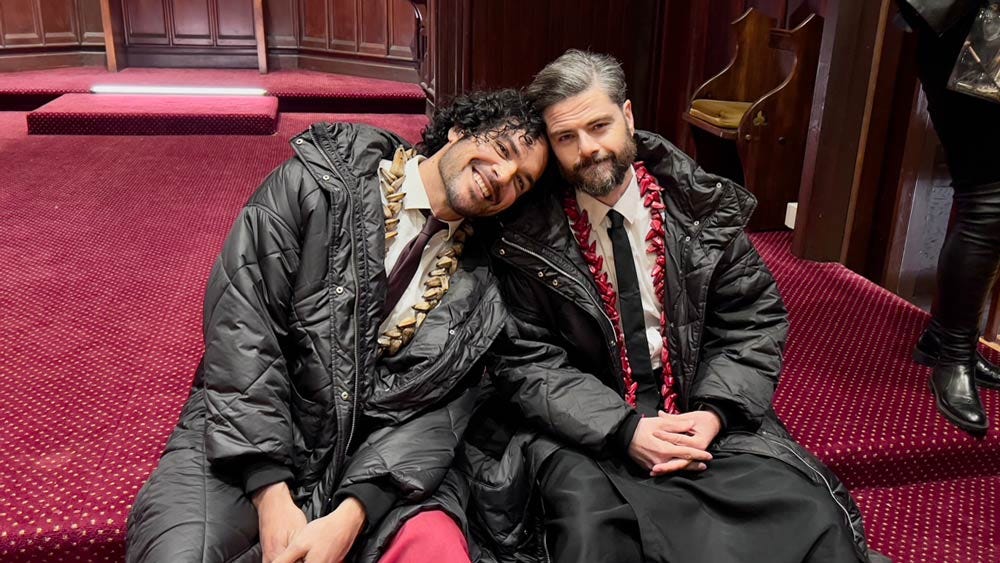
(Nick Afoa and Richard Short. Photo provided.)
Kilian Melloy: Something that jumped out at me was how the slur “paedophile” is thrown at the characters in this film. That’s one of the anti-gay right’s favorite lies about us, and it’s been resurrected in the States in recent years. Has it also come back in New Zealand, and was it a late addition to the script as a result?
Paul Oremland: I guess it was a late addition [to the film], although it's something I was aware of. It's a thing that people use to attack, and it's been around for a long time. It’s not true, obviously, but it was an accusation that was often thrown at people, and it has been resurrected in a horrific way.
Kilian Melloy: It was a surprise. I had thought New Zealand was a little bit more advanced than the States. I mean, you had marriage equality two years before we did.
Paul Oremland: I want to beat the drum for New Zealand. In some ways, there have been amazing advances. New Zealand is a wonderful country, and is very welcoming, but I think some of the… I'll use the word poison… that exists, particularly in the far right and the evangelical right from America, is filtering down into New Zealand. We have a church here called the Destiny Church, which are constantly attacking gay people and coming up with the “grooming” [claims], and all this sort of thing.
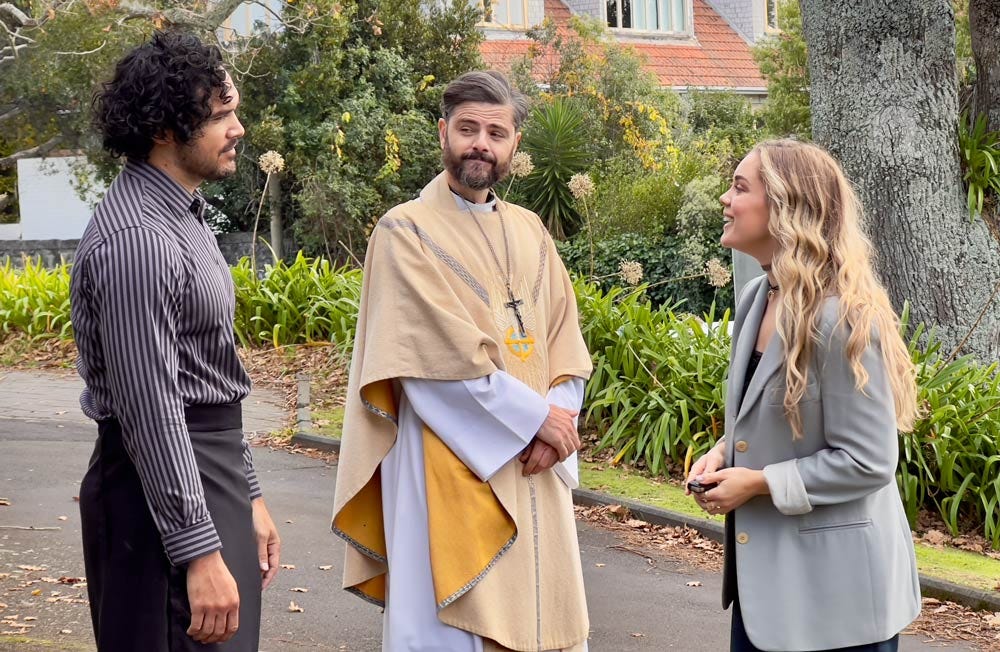
(Photo provided.)
Kilian Melloy: The film addresses various political, religious, and social issues, but it stays centered on characters we can care about, which is quite a feat.
Paul Oremland: It was always a love story, and it was always a biracial love story. Getting that right was quite tricky. I worked very closely with Dianna Fuemana, who was my co-writer and is a very respected Samoan playwright, on some of the deeper things to try and make the characters real. It was it was a struggle to get it right. I didn't want it to be a polemic, but at the same time I wanted to explore issues.
Kilian Melloy: I think the reason the story gels the way it does is you found your way into it through Peter, the Anglican vicar. He risks making the struggle about himself rather than actual injustice, and he’s even overlooking the needs of his partner, Jason, who doesn't want to be part of a media frenzy.
Paul Oremland: When you're writing something, one of the characters is yourself — and dare I say it, Peter’s a little too close to home occasionally. He’s prideful and he's patronizing. It's not me, obviously… Also, Peter hasn't struggled in the way that Jason did. He comes from a safe, secure world, and he has, in the words of Jason, a lot to learn.
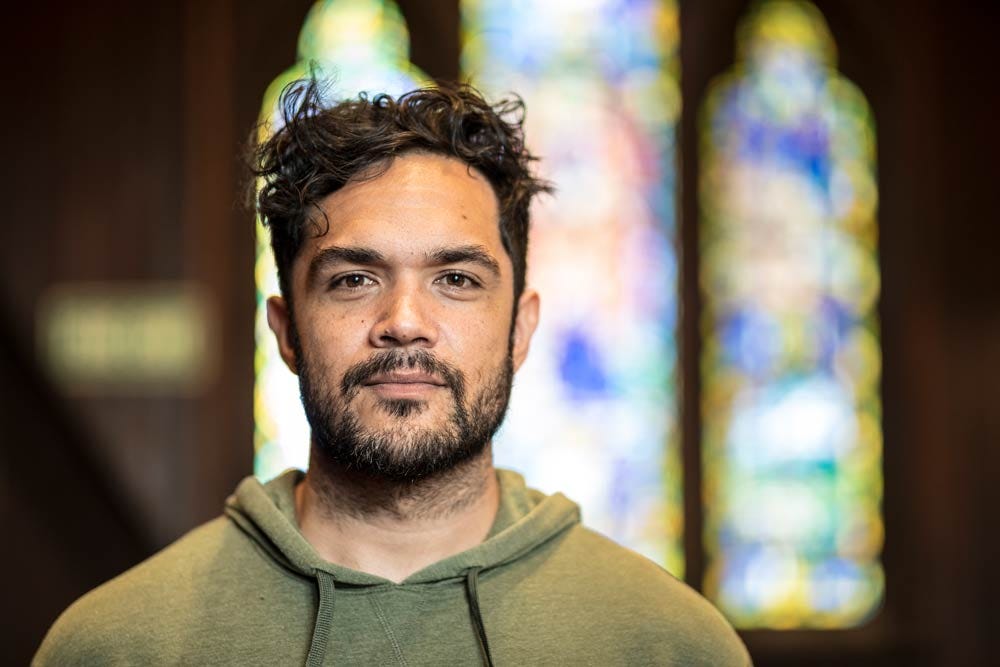
(Nick Afoa. Photo provided.)
Kilian Melloy: There's a lot boiling under the surface for Jason. He's embarrassed and upset because of the way his past is depicted by the media. He goes cruising in the park at one point because he's so stressed and angry, which doesn’t seem like an obvious choice for the character, but it gives him intriguing layers.
Paul Oremland: Jason has a dark past, but the important thing is that Jason has changed, and I think Nick’s performance captures that in a way that, for me, he's the hero of the film. Nick did an amazing job. His father, I think, was an Anglican minister, and Nick himself was a rugby player. This is his first big acting role. We shot the film in 16 days; he was just thrown into it, and he really embraced it.
Nick, and everybody involved, particularly from the Pacific community, were quite brave. [Being gay] is a hugely taboo subject within the Pacific community. We had a number of actors who simply said that they wouldn't do this because of the subject matter.
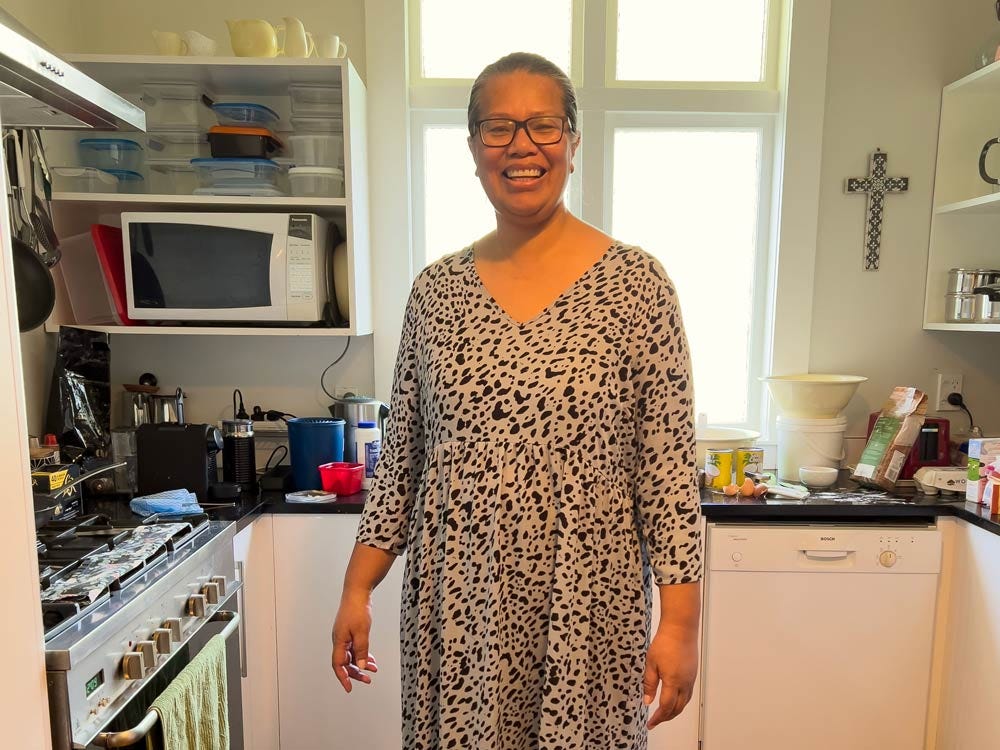
(Maureen Fepuleai. Photo provided.)
Kilian Melloy: Jason’s Aunt Nora is an extremely interesting and complicated character. On the one hand, she doesn't like that they're getting married because marriage is a sacrament in the church. On the other hand, she also points out that in the traditional culture, before the Christian missionaries took their heritage from them, they honored trans people.
Paul Oremland: I have to be a little careful here because, you know, I'm not an expert on this, and it's something Ngaire Fuata, who’s my producer, or Dianna certainly know more about, but faʻafafine are more complicated. They're like the third gender; they’re not trans as we understand it, and there's quite a spiritual element toward that in traditional culture. Aunt Nola, very much like Maureen [Fepuleai, the actress who plays her], is struggling with it. Maureen is a devout Mormon, and she said, “Look, I struggle with this, but I know the pain and I see the pain in my own family.” [Aunt Nola] struggles with it, but she also recognizes what's important is love. And, you know, that's the message of the film.
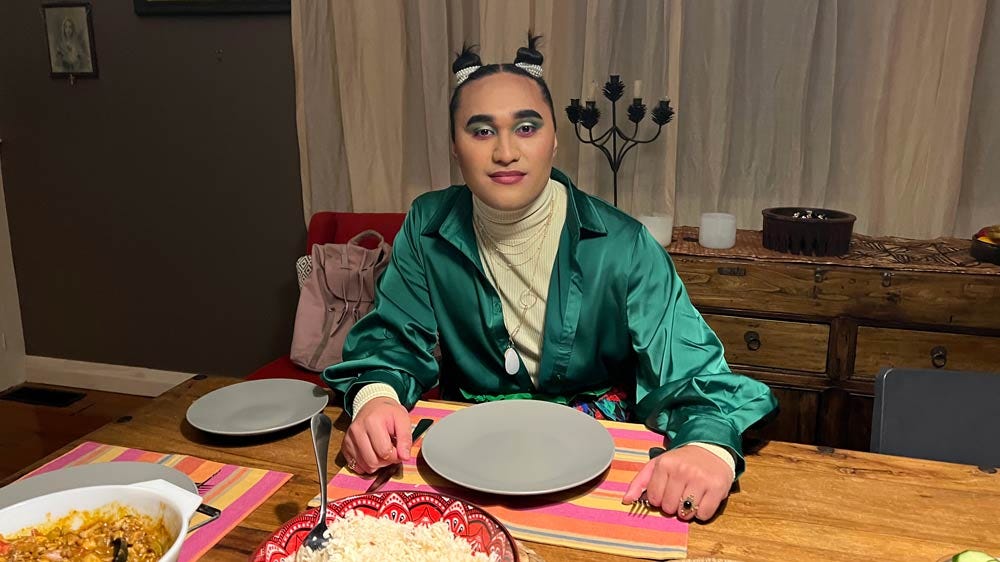
(Joe Malu Folau. Photo provided.)
Kilian Melloy: Nick’s nephew is another fascinating character. A viewer can look at him and truly believe he would be a Gen Zed influencer on social media and be organizing everything and putting the wedding together.
Paul Oremland: Indeed, which is actually the role, interestingly, for faʻafafine in Samoan culture — to organize things. Joe just absolutely nailed that. One of my favorite scenes, which Joe ad-libbed to some extent, is where the parishioners are coming out of the church, and he just takes over, saying to them, “Thanks for coming.” He really captured the essence, and Joe is nothing like the character at all. I mean, he just brought it to life.
Joe caught COVID a week before we were due to start filming. We had no time to rehearse. I’d never seen him in costume until the day he walked on set. In fact, we had to shift the schedule around; the first day of filming with Joe we had to shoot something like 14 minutes of screen time, which was just absurd. And he just nailed it, straight out of drama school.
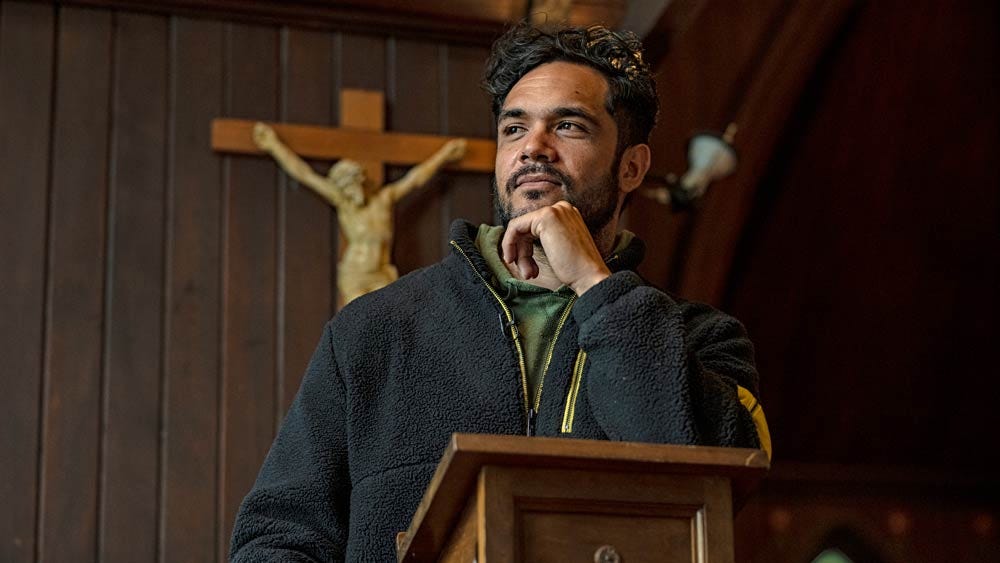
(Photo provided.)
Kilian Melloy: The film makes a bold choice in putting in a supernatural twist.
Paul Oremland: People have been critical of the ending a little bit. Some people love it. It's divided people, and I think a good film should do that. What did you think of it?
Kilian Melloy: I like it, because this is a movie about a man who stands up not just for himself as a human being and a member of a faith community, but also for the belief that God has created him specifically to be who he is, and to be who he's with.
Paul Oremland: That's exactly right. It's difficult to talk about this without giving things away, but when I shot the film I absolutely believed it was [divine intervention]… but at the same time, I'm an atheist. So, I combined those two things. It's a combination of faith and love.
Kilian Melloy: I like how you represent a demographic of older men who don’t come out, or maybe even realize they are gay, until midlife.
Paul Oremland: The thing about Peter was that he was married, and was happily married. I've met a number of men who have been married and then realized that were gay and had to come to terms with that. But that doesn't negate the relationship they had with their wives or their children.
Kilian Melloy: You emphasize that in the film through Peter’s adult daughter, Kate, who is so adorable and accepting.
Paul Oremland: I think in some ways she represents change. It is wonderful to meet young people who are totally accepting in a genuine way and in a respectful way. It's been wonderful to see Pacific people have embraced the film down here. TVNZ, which is the main broadcaster, put the film out Easter Saturday in primetime on New Zealand television, which was just incredible. And they played the film in Rarotonga, in a church hall. It's still illegal to be gay in Rarotonga, and here they were playing our little film in a little church hall in Rarotonga, and that is the thing that makes me most happy about the film.
Kilian Melloy: What do you have coming up next, you might share with us?
Paul Oremland: I've started a script on a New Zealand Prime Minister, a biopic about Michael Joseph Savage. He was the first left, or Labour, Prime Minister of New Zealand, and it's a very big tale in which he brings about huge change. He brought New Zealand out of the Depression, took New Zealand into the Second World War, and ultimately he sacrificed his life for his political beliefs. It's an amazing story, and I can't make it on a shoestring, so, who knows what's going to happen. It's a very different story, but it's still about conviction and belief.
This interview was conducted on May 8, 2024. It has been edited for length and clarity. Mysterious Ways is available to stream at Apple TV, Dekkoo, and Prime Video.