
Interview: S.E. King and Danielle Healey Spill the Tea on 'Our Dad, Danielle'
They were once neighbors. Now they've teamed up to make an illuminating documentary on the trans experience.

The first time patent attorney Danelle Healey ever admitted to another person that she was transgender, it was to a psychiatrist she saw in her mid-40s. That moment started her on a journey of self-acceptance, and transition, that saw her accept her true self, even though some others were unable to be as accepting of her.
“I lost most of my clients, and I lost a huge part of my practice,” Healey tells me, “and I fell from being the white male with power and money at the top of the food chain to being the fat, ugly trans lady down near the bottom. That was quite a fall, and quite an adjustment.”
Even so, Healey adds, “I thank my lucky stars that I happened to find supportive people, and I've rebuilt my practice, and now I'm doing well. I'm at a very supportive [law] firm. I'll never have that mansion again, but I'm optimistic about the future.”
Healey talks about such insights in S.E. King’s documentary Our Dad, Danielle, a film the self-described “non-binary lesbian” filmmaker came to make thanks to having once lived next door to the Healeys; or, rather, it was the other way around: The Healeys had lived next door to Hinton and their family in the conservative Texas town of Sugarland. When Hinton’s father retired and sold the house, the Healeys bought it. Decades later, knowing that Hinton was a filmmaker, Danielle, newly transitioned, reached out with the idea of making a web-based sitcom based on her life and that of her family, who had stuck by her. The sitcom didn’t pan out, but once Hinton and the Healeys began working together it became obvious a story was there for the telling. They didn’t need to make a sitcom; all they needed was to tell the story as it was.
The film was a journey for Hinton, as well. “I started to become more and more honest with, and stopped censoring, myself,” they tell me of the impact making the film had on them.
This interview was originally conducted in October of last year, before the 2024 election, and the barrage of lies told by the current government and by pundits about transgender people has only intensified since then. Read on to see what Danielle and S.E. revealed about their lives, making the movie, and their thoughts about what the next four years will mean for queer Americans.
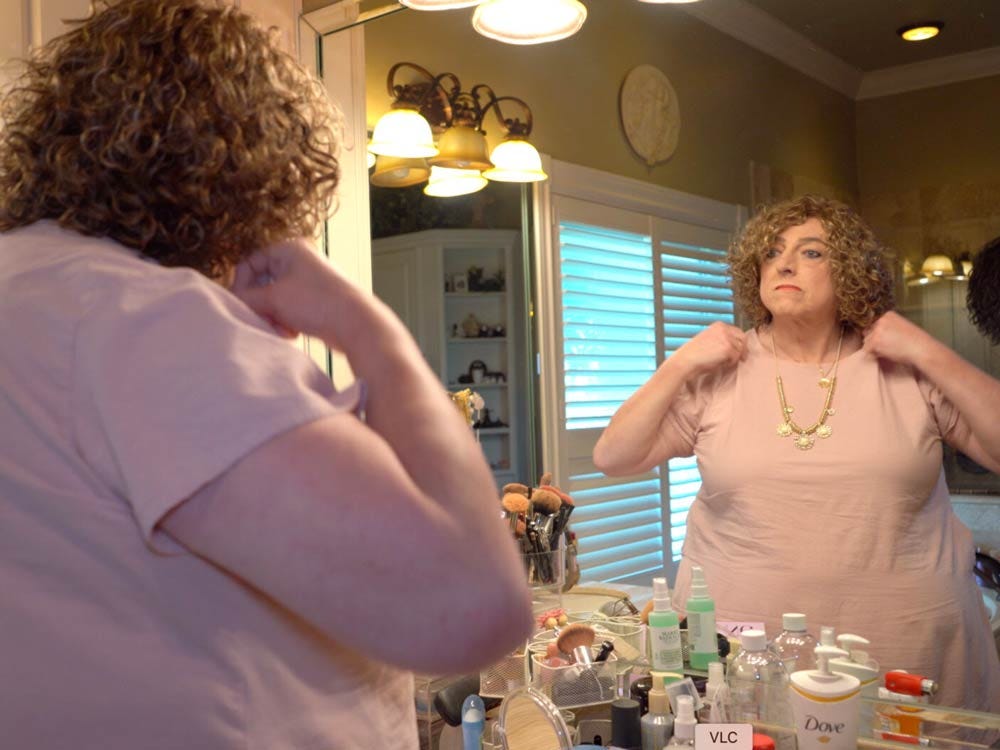
(Danielle Healey in Our Dad, Danielle. Photo supplied)
Kilian Melloy: Danielle, you make it clear that being transgender is not a choice, nor was it a “phase” you grew out of, and it is not a matter of “playing dress up.” Do you have to push back often against those tropes?
Danielle Healey: I've heard [those tropes] again and again. A four-year-old isn't making a choice. A four-year-old hasn't been influenced by social media. A four-year-old is following who they are in their heart and soul and their instinct. You hear about parents who try therapy and all this other stuff, and the kid just becomes a nightmare to deal with because they're being forced into this box that they don't belong in. And finally, something will happen when the parents let the kid out of the box: Overnight, the kid turns into a happy child. Whether it's genetic or whatever, it's not play time. It's not a choice.
When I was growing up in the ’60s, there was no social media. There was nothing about trans people. I think when I was 13 or 14, there was an article in Time that was a little squib about a teacher in Colorado who had transitioned. The internet didn't come along until I was in my mid-30s, and it wasn't until the internet came along that I realized there were other people out there like me. I thought this was a disease. I thought this was a horrible thing to be afflicted with. I went to psychiatrists. I went to doctors. I tried everything I could to deal with this and to get rid of it. I finally went to this one psychiatrist, and we talked about it for several sessions, and he said, “You know, you felt this way since you were four. You tried medical treatment, you've tried psychiatric treatment, you've gone to church.” I was trying to pray this away. “And you're 44 now, so it's been 40 years.” And he looked at me and said, “I don't think it's going away. It’s just who you are, and you're gonna have to live with it.”
Kilian Melloy: S.E., at what point did Danielle's story become exciting for you?
S.E. King: Right out of the gate. Initially I said yes to Danielle's idea [of making a sitcom] because I love Danielle and her family. Then, the first day [of shooting], Becky was adorable but a terrible actress, and Danielle’s coming out was still fresh. You could sense that in her performance and in their dynamic. Immediately, I was like, “God, I would love it if they'd be willing to talk about this in a documentary.” They said, “You can interview us, and then we'll see how we feel.” That's what we did: We spent a day and asked some questions, and then I chopped something together to present to them, and they said yes. We were fortunate to win a grant, and we did crowdfunding and all those wonderful things to keep the movie afloat.
I don't think any of us, in the very beginning, thought we would make a feature, and we definitely didn't think it would be such a process. But I'm glad that we were able to spend the time to really see Danielle's life unfold, because it adds so much more, like a tapestry of her dynamic life, and you get to see Becky's processing of it naturally; she doesn't censor herself. Then you see how she feels towards the end. Everyone's timeline is different, and everyone's processing of this is different. That was important for us to explore.
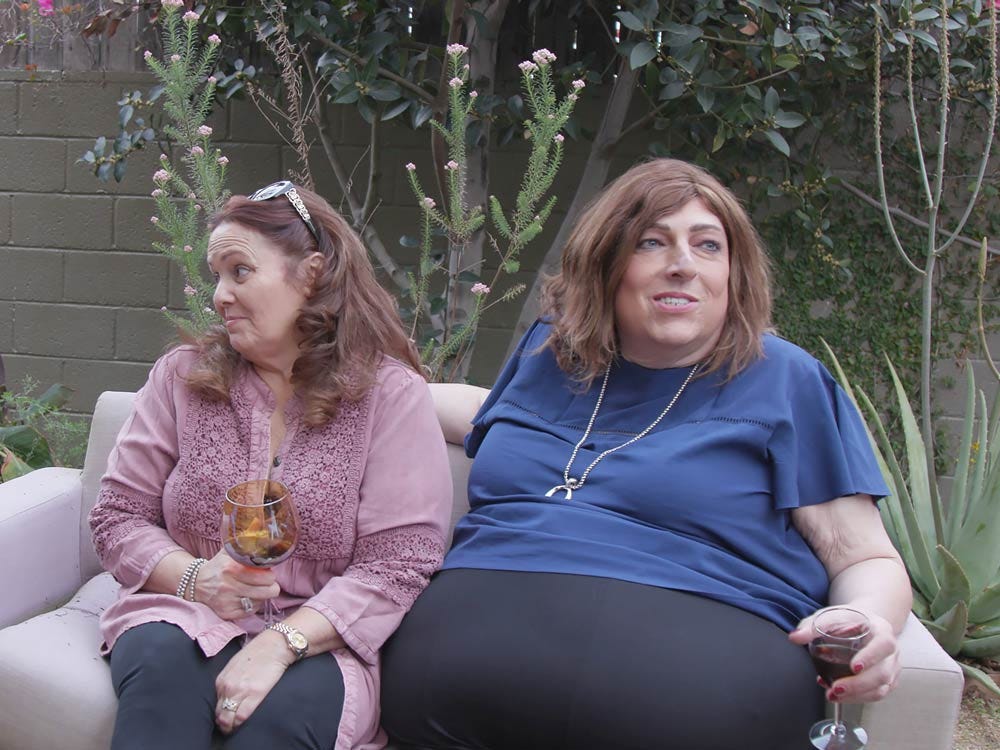
(Becky and Danielle Healey in Our Dad, Danielle. Photo supplied)
Kilian Melloy: Danielle, you mention in the doc that you feel you got your ability to problem solve and think out of the box by having had to deal with being trans all your life.
Danielle Healey: Because of my circumstances I've had to look for different solutions to very hard problems, and that's become my forte. One of the things I have been known for in the law is coming up with very creative and powerful solutions the problems, and I enjoy bringing that to people.
One of the things I will say real quick is there was an HBO documentary about this mother in Oklahoma — her son had transitioned, and he said to her that he was dealing with gender all this time, and the mother said, “You know, I never think about being a woman. I just am a woman.” And I was like, “That can't be true.” I thought about my gender constantly, all day, every day. It was like having a sharp spring between my shoulders all the time, this tension. I called one of my best friends who was accepting and knew my story, and I said, “This woman says she never thinks about her gender.” And my friend said, “Well, neither do I.” And I'm like, “How is it that I think constantly about my gender, and you never do?”
About three months after I transitioned, I was driving in the car, and I realized that spring between my shoulders is gone. And then I realize I hadn't thought about my gender for the last three months. As much as I was dealing with the consequences of transition, I was no longer obsessing with, “What's going on? What's with my gender?” I just wasn't thinking about it once I transitioned.
Kilian Melloy: S.E. did you feel like this story was something you were heading toward in your career?
S.E. King: Yes. I was drawn to it immediately as a non-binary lesbian who has so many similar [parallels] to Danielle's story. I have set out in my career to work on LGBTQ content first and foremost, and so that's a very important thing for me and my partner, who's a producer on this movie. We don't work on anything that doesn't either focus on women, LGBTQ people, or any underrepresented voice.
Before this film I was not in a good place. Seeing Danielle's transition and meeting these other women really did save my life. I felt like I had a purpose again. One of the things that really changed me was seeing Danielle blossoming into who she really is and seeing how that affected every aspect of her life. But before I started putting on layers and layers of performance around what it meant to be a woman, I just shed all of that and was able to be like, “No, I'm gonna meet my mom and dad just how I am, with nothing but honesty and integrity,” and that process is not easy for everyone. So, yeah, I would have done something similar, but I'm so glad this was the movie that that kicked it off.
Kilian Melloy: Danielle, you do legal work for LGTBQ+ migrants fleeing persecution from other countries. Seeing how hard it is for them, and how trans Americans have been attacked by their own lawmakers under the Biden administration, how much worse do you think it would get [under a second Trump term]?
Danielle Healey: I think it will get worse, mainly because of two factors: One, the appointment of judges. People don't understand the tremendous impact that has on the law. The other thing is immigration law, [which] is based on a bevy of regulations and a huge, cumbersome set of bureaucracies. If the regulations are changed, it could become just a way to exclude people from this country.
The stories that I come across are unbelievable. Trans women from Honduras are under threat of death, and most of them flee the country. Of all the trans and LGBT people I've represented in asylum proceedings, none of them had planned to come to the U.S. Not a single one. Something happened to each of them where they grabbed some money and just left. It was not a well-planned decision. If they could go back home, I think they all would, but they can't.
Kilian Melloy: What ray of hope do you see?
Danielle Healey: Generational change. Younger people tend to understand the idea of gender. They're not as boxed in by the “traditional values.” And I think that when we get this current crop of politicians out of the way [the situation will improve]. They're [going on about] trans girls in in sports. How many trans girls are in sports? I think at one point, there was a study that there were 66 trans girls in sports in the United States. This is not a pervasive problem.
It's going to drop off the radar screen with generational change. They will no longer get political mileage out of demonizing trans people.
S.E. King: They’ll find someone new to demonize.
Danielle Healey: Yes, of course.
S.E. King: But to Danielle’s point, I think it's exciting to see the change [happening]. They can continue to try to fight us and do what they're doing, but it only inspires more activism, more truth, more community-based coming together. We’re stronger when we're together, and then, man, look out: We're unstoppable. Plus, some of the most incredible artists and some of the most influential people throughout history have been LGBTQ, and it's important that we recognize that all of these beautiful people have something to say. When you try to silence that, look out! You're in trouble.
This interview was conducted on October 29, 2024. It has been edited for length and clarity. Our Dad, Danielle is available now on VOD and digital.