
Interview: Bruce Vilanch Explains Why "It Seemed Like a Bad Idea at the Time"...
And yet, as he details in his new memoir, was was still involved with "Some of the Worst TV Shows in History."

As Bruce Vilanch signs onto the Zoom meeting, “Travis Kelce’s Mother” appears on the screen. It’s a joke he’s been telling lately, referring to how he and the mother of the famed Kansas City Chiefs tight end — and Taylor Swift’s boyfriend — could be confused at a distance due to their blond hair and red-framed eyeglasses.
What Mrs. Kelce doesn’t have, however, is Vilanch’s signature T-shirts. Today he’s wearing a tee that parodies of 1950s advertising with a carton of a dishy woman holding up a baked good under the words “Worst Pies in London.” Are we advertising the menu at a certain notorious establishment on Fleet Street?
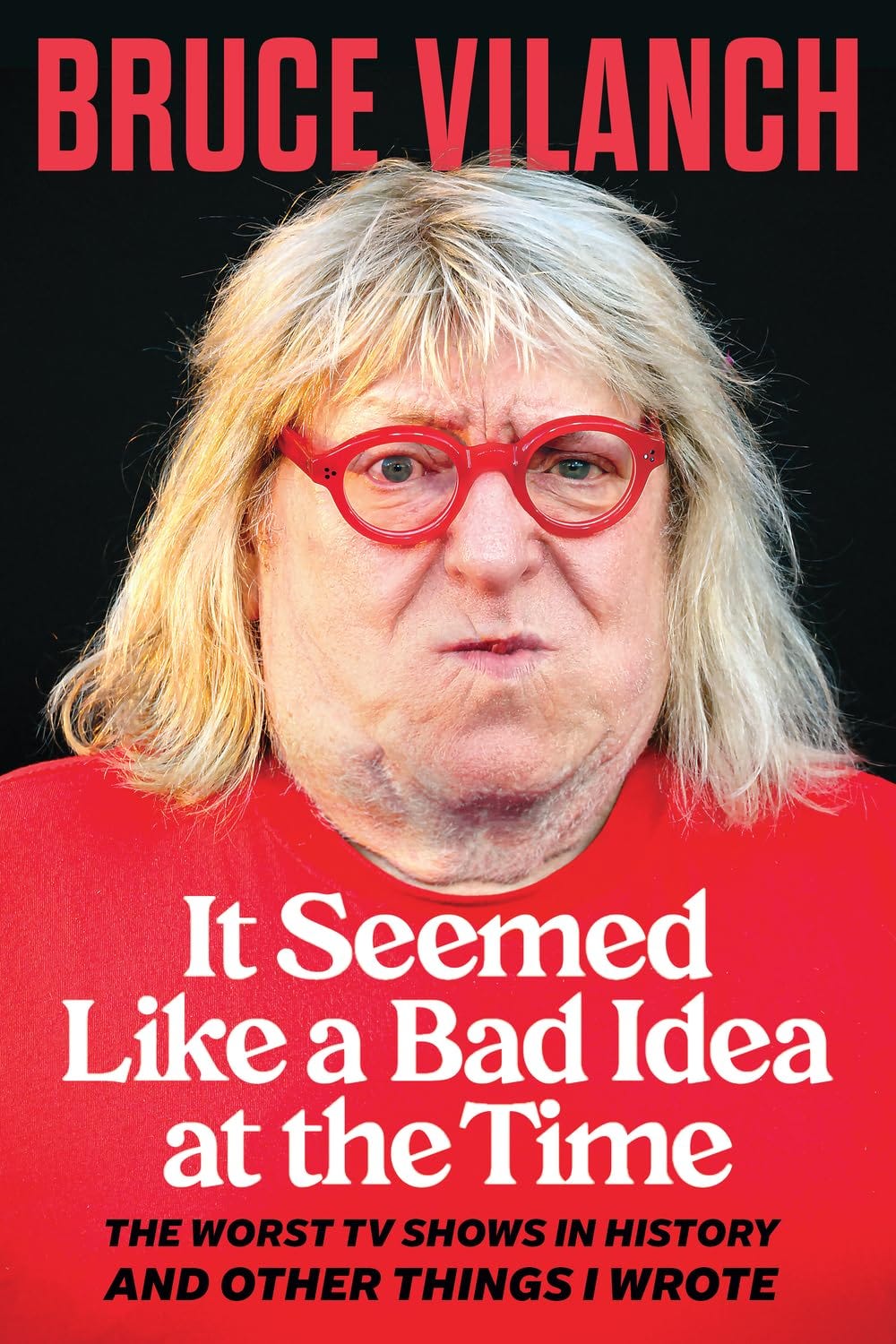
If so, it would fit the bill for today’s chat: A conversation about Vilanch’s new book, It Seemed Like a Bad Idea at the Time: The Worst TV Shows in History and Other Things I Wrote, a memoir not of his greatest hits but his most infamous misses — awful camp classics like The Star Wars Holiday Special, the movie Ice Pirates (in which Vilanch himself has a role as a disembodied head — just one of his 50+ acting credits), the disco-infused movie Can’t Stop the Beat (which arrived in 1980, just as disco was fizzling out), and even… who knew?... a short-lived variety hour in which the cast of The Brady Bunch reunited, in character, to play their familiar roles in a whole new setting… as a singing, dancing family troupe with a weekly show. (It comes as no surprise when Vilanch spills the tea that the project was originally conceived as a vehicle for the cast of The Partridge Family.)
The openly gay comic’s career has been characterized more by shining successes than the sorts of missteps he writes about in the new book. Yet, while he’s been part of Hollywood for half a century (working with, writing for, and befriending stars from Hollywood’s Golden Age right up to the current moment) it might not quite be clear what it is, exactly, for which the funnyman is famous.
A lot, as it happens. Credited with writing 25 Oscars ceremonies (Vilanch places the number at more like three dozen, counting uncredited rewrites), not to mention countless Tony, Emmy, and Grammy awards shows, Vilanch got his start as an entertainment journalist before co-writing the Bette Midler vehicle Divine Madness.
Since then, he’s provided material to what seems like every comedian in the business and written or co-written countless specials, TV shows, and films. He served as head writer for Hollywood Squares for several years, as well as occupying its “celebrity box,” from which — like Paul Lynde before him — he fired off quick-witted quips. He’s even had a one-man off-Broadway show, Bruce Vilanch: Almost Famous. (Don’t get that confused with Platinum, the short-lived Alexis Smith-starring Broadway musical for which he co-wrote the book; that gem ran all of 33 performances, plus a dozen previews. To be fair, Platinum also garnered a few rave reviews and its songs, by composer Gary William Friedman and lyricist Will Holt, who also co-wrote the book, are considered by some to have been unjustly overlooked.)
Bruce Vilanch chatted about his unusual memoir, the stars he’s worked with, and his other current projects.
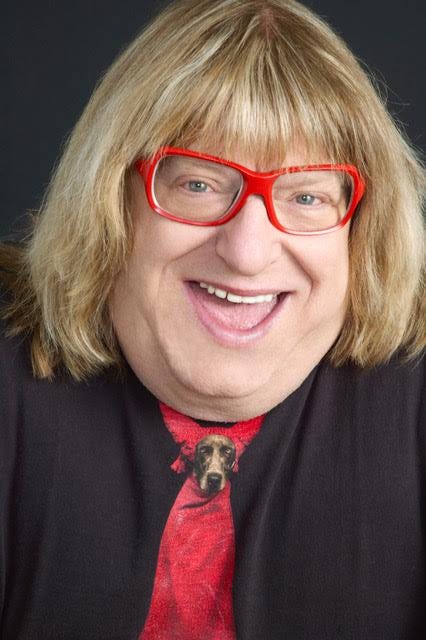
(Photo provided. Credit: Rick Stockwell)
Kilian Melloy: I understand people have been mistaking you for Travis Kelce’s mother.
Bruce Vilanch: I just was on The View this week, and it's gotten tremendous play. I mean, it got picked up by the Daily Mail in London. I kept saying, “I'm going to ride this joke. I hope [Travis Kelce and Taylor Swift] stay together.” I thought I'd try it out on you.
Kilian Melloy: Have you heard anything from Travis Kelce’s mother, or from Travis Kelce?
Bruce Vilanch: No. I hope she's not offended. But we do look a lot alike.
Kilian Melloy: People have been coming up to you and asking about it.
Bruce Vilanch: I mean, I got all the calls. I don't think she got calls saying, “Oh, God, you look like Bruce.”
Kilian Melloy: There is a resemblance with the blond hair and red eyeglasses frames, but you have the novelty T-shirts. What’s the story with those?
Bruce Vilanch: I was a fat kid, and when you were a fat kid nothing ever fits. When I found T shirts, I thought, “Oh, this is wonderful.” I moved out here in the ’70s, and it was T-shirt heaven. I could wear T-shirts anywhere in LA. It’s a very informal kind of place. I got into it — with a body like this, you have to show it off.
Kilian Melloy: What sparked the idea for a memoir based around infamous TV shows and movies? Were you thinking about writing a memoir of a different sort, and then realized this could be funnier?
Bruce Vilanch: I've never wanted to write a memoir. Nobody cares who I slept with, so I wasn't going to do any of that. I'm not Shelly Winters. Everybody in her book she slept with was dead; I [told her], “You should call your book Fuck Shelly and Die, because that's what it was.
[Laughter]
Bruce Vilanch: It was during COVID, it was a lockdown, and we were all on podcasts. All these people who were not born when these shows came out had seen them on the internet, and they said, “How did this happen? Who said yes to this?” I thought, “There's a book in this, how I was a part of all of these awful things and survived.” This is a memoir, I suppose, but it's not conventional.
Kilian Melloy: It's not necessarily easy, in the middle of creative foment, to separate out good and bad ideas.
Bruce Vilanch: Sure you can, but somebody comes in, the idea is rotten at the core, and you go, “That's just terrible. How much do they pay? Oh, I see how I could make it work!” We talk ourselves into it, and then we're stuck. It's kind of like, “This isn't really quicksand, this is just a dune.” All of a sudden, you're wildly sinking and hoping for a rope.
Kilian Melloy: There's such an undercurrent of queer humor in the memoir. Is that also there in your other stuff, but it tends to slip by audiences?
Bruce Vilanch: On Hollywood Squares, that was absolutely the case. The model was sort of, “If they get it, that’s a laugh; if they don’t, whoosh, it goes over their heads, and then move right along.” This is how people like Paul Lynde and Charles Nelson Riley and Richard Simmons were in the limelight in the post-Stonewall days, and nobody seemed to mind.
Kilian Melloy: It's hard to imagine that you've never not been out, but when you were first starting in your career, it wasn't so easy. Did you find that it was an issue?
Bruce Vilanch: It probably was, but I didn't notice. I had determined that I didn't want to work with people who were not going to work with me because I was gay, and it didn't seem to get in my way. I'm in a business where eccentricity and flamboyance are celebrated, and there are a lot of characters, so it became one of these weird character traits. And the fact that I was so out impressed a lot of people. It was right after Stonewall, so there was a lot of consciousness about people coming out. It didn't really begin happening for real until AIDS happened, and people realized that they had to come out in order to save their lives.
I had read Merle Miller, a historian who was gay and out, and said, “A faggot is a homosexual gentleman who has just left the room.” And I thought, “Well, okay, I'm going to be the person who tells them to your face: ‘By the way, when you [make jokes about gays], you’re looking at one. I'm one of them.’ ” When you’d call attention to [homophobic remarks] they were startled that you would take offense, because it was a common thing to make [homophobic] jokes. When they would say gay is a choice, I'd say, “Yes, it's a choice to be your authentic self. It's a choice to be true to yourself. That's a choice. It's not because those things look good between your legs.”
Kilian Melloy: Do you have a sense that we may be going to see the kind of activism in our own defense that we had during the AIDS crisis?
Bruce Vilanch: It’s a different playing field than it was when AIDS happened. We’ve become much more sophisticated, but at the same time our tent grew wider. Now, if they sincerely go after Obergefell [the Supreme Court decision that legalized marriage equality in all 50 states in 2015] and try to reverse it, I have a feeling they’re going to have a hard time telling Pete Buttigieg his marriage is illegal. It's at that level that we have to fight. We have to fight with people who have been married, and who are part of established law, and who are significant individuals. At the moment, it's just a lunatic in Idaho introducing a bill in the state senate [to undo marriage equality], but we'll see.
Kilian Melloy: Let's talk about something a little more fun: What's next for you?
Bruce Vilanch: Well, I've written this play, and that's the immediate thing. Once I'm done with the flogging of the book, we're going to do a little workshop production of this thing and see how far it goes. And then, who knows after that? Anything can happen. I could marry Lance Bass. Oh… he's married already? Okay, never mind.
This interview was conducted on March 7, 2025. It has been edited for length and clarity. It Seemed Like a Bad Idea at the Time: The Worst TV Shows in History and Other Things I Wrote is out now in hardcover from Chicago Review Press: https://www.chicagoreviewpress.com/it-seemed-like-a-bad-idea-at-the-time-products-9780914091929.php