
Celluloid Revelations: James DuVal on Gregg Araki's 'Teen Apocalyse' Movies
The veteran actor opens up about some of his most famous roles

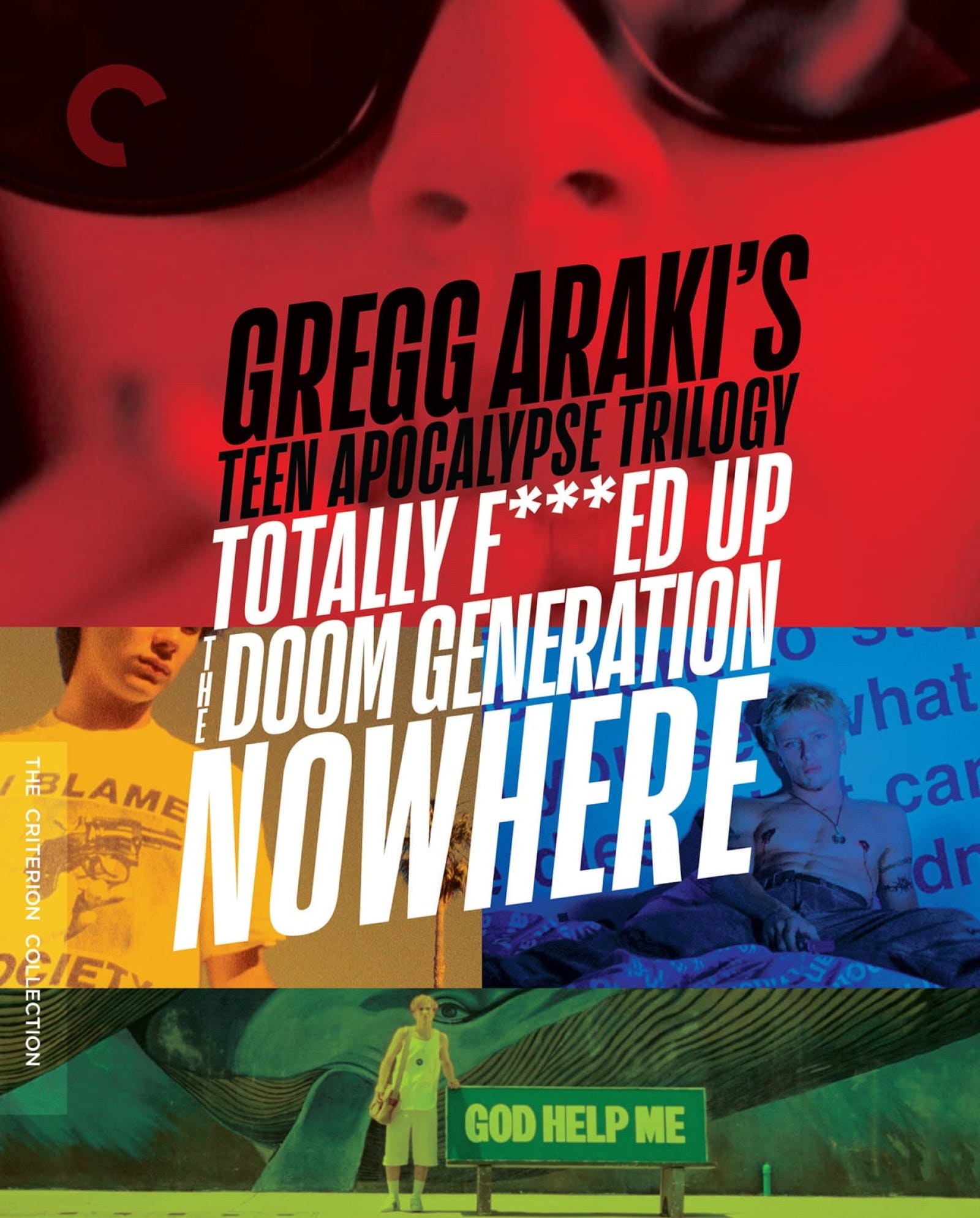
From B-movie aliens to homophobic, homicidal maniacs and all sorts of oddball moments in between: Such are the ingredients to Gregg Araki’s “Teen Apocalypse” trilogy of movies from the 1990s, which The Criterion Collection has digitally restored in 2K and 4K editions and made available on Blu-ray and 4K+Blu-ray.
From the shoestring indie sensibilities of Araki’s filmography and the iconic Jake Gyllenhaal-starring film Donnie Darko (2001) to big-budget blockbusters like Independence Day (1996), James Duval — a longtime Araki collaborator and star of all three films in the “Teen Apocalypse” movies — has enjoyed a varied, and busy, career.
Barely in his 20s when the first of the “Teen Apocalypse” movies, Totally F***ked Up, was released in 1993, Duval portrayed the sexually conflicted main character, Andy. Filmed in documentary style, the movie follows a group of teenage friends as they navigate shifting sexual loyalties, many of them involving queer relationships. From there, Duval worked with Araki on 1995’s The Doom Generation, playing the part of Jordan, a naïve teenager who, together with his more streetwise girlfriend, Amy (Rose McGowan), picks up a sketchy guy named Xavier (Johnathan Schaech), only for lethal sexual chaos to ensue. Duval returned for the third of the “Teen Apocalypse” films, Nowhere, in 1997, playing Dark, one of a number of high school students whose shenanigans and quest for love is overshadowed by mysterious otherworldly visitations. (If a semi-sci-fi movie can be considered to be an extended joke, then Nowhere has the best punchline of them all.)
Duval has acted in mainstream movies like Gone in 60 Seconds (2000), Chasing Ghosts (2005), and Standing Still (2005), but he returned to work with Araki on 2010’s Kaboom! Given the queer messaging in Araki’s movies, and the nature of the roles he played in the trilogy — young men exploring homoerotic urges or awakening to queer identities — it would be natural for the viewing public to wonder if Duval himself identifies as queer. He’s pushed back on such questions; asked in an interview about what he wishes people would stop asking him, Duval answered, “ ‘So, are you really gay?’ It doesn’t bother me when people ask’ the actor added, “but — God, isn’t there anything else?” Duval went on to say, “I do have a girlfriend. Sorry.”
In a different interview (conducted jointly with Araki), Duval recalled, “Before I made these film with Gregg, I did a lot of these truth and dare things. You go into the closet with a girl. You’d go into a closet with a guy…. We did these things to be OK with who we were outside of the confines of society. Gregg gave me an arena to explore this further.”
Explore he did, embracing the narrative strangeness and queer messaging of Araki’s films.
I caught up with James Duval to hear his thoughts on Criterion’s deluxe treatment of the “Teen Apocalypse Trilogy,” the progress that LGTBQ+ people have made since the 1990s (and the backlash we’re seeing now), and whether he might be joining in on the fun as Araki reportedly prepares to make his next film.
(Criterion Collection)
Kilian Melloy: How much of a thrill is it that Criterion is bringing out this trilogy of films and to see it upgraded now into 4K and 2K restorations?
James Duval: It’s more than a dream come true to have Criterion be putting it out. Criterion has always been the marker for films that were educating people in cinema, that filmmakers and actors might not ever have had a chance to see if they didn’t preserve them. I’m quite emotional about it in a very happy way
Kilian Melloy: Gregg Araki’s movies feel a little like John Waters films and a little bit like Roger Corman films. Did that sensibility appeal to you when you were first starting to work with him?
James Duval: It appealed to me very much. I was already very much a huge fan of John Waters. I met Gregg when I was 18, but I started to dive into indie film around 16 or 17, and I remember the first thing I saw was The Cook, the Thief, His Wife, and Her Lover, by Peter Greenaway.
Kilian Melloy: A classic!
James Duval: Seeing it at the time, I was so horrified and fascinated, and strangely attracted. I didn’t know you could do these kinds of things in a film, and so I kind of dove straight into my cinema education. But also, I was starting to do extra work. I remember, at the time John Waters needed to do reshoots on Crybaby, and he needed extras, so I went into extra work over the weekend for John. After Crybaby, I went back and started to watch all his older movies, [like] Female Trouble. It was probably right at the very beginning of doing Totally F***ed Up, and John had a screening at the New Art Theater of Pink Flamingos.
Gregg was a big part of my cinematic history education, as well. While we were shooting the [Totally F***ked Up], I had a chance to see The Long Weekend (O’Despair), and I had a chance to see Three Bewildered People in the Night, and Greg does have this kind of wackiness in all of his movies, that bizarre sensibility [that] is directly inspired by John Waters.
(Criterion Collection)
Kilian Melloy: In these three movies, your characters are all working out who they are — bi, straight, whatever. Did you have a sense in your own mind for what they were figuring out, and how to play them accordingly?
James Duval: I mean, I was certainly going through the same struggles myself, and so that helped a lot. I was very young — 18, 19, 20 — and I think for most of the actors, we were trying to figure out who we were, what we were about, what things meant to us. The incredible thing with Totally F***ked Up and Doom and Nowhere was to be able to read something that could articulate how I felt in a way that I couldn’t. Gregg gave me room to express myself in those ways.
Kilian Melloy: Someone says in the commentaries somewhere that Gregg Araki never allowed for any kind of ad-libbing, so was it a matter of good casting that what he was writing for you spoke to you the way it did? Or was he connecting with you as a person in order to write those lines for your character?
James Duval: In a lot of ways all the characters are pieces of Greg, so he has a first-person emotional understanding of the characters. When he started writing Doom and Nowhere he knew me, so he had me specifically in mind. By being able to write the characters of Jordan and Dark for me and give me the space to play that out, [Araki] let me live that in real life while filming it, in a lot of ways. I attribute that to Gregg’s genius of being not only able to understand the struggles of somebody who was 10, 11, 12 years his junior, but being able to articulate them, and articulate them in a way that I didn’t know how.
Kilian Melloy: Totally F***ed Up starts off with a headline about gay suicide rates, and that’s something that the country kind started to wake up to in the 2010s – but now it feels like we’re going backwards. Can movies like these give us hope?
James Duval: I think telling these stories is absolutely integral. In a lot of ways, I would never have found myself the way I found myself if it wasn’t for [Gregg Araki]. I don’t know if I would be here if it wasn’t for him.
But even more than that, speaking to some audience members who had watched [Totally F***ked Up], some people thought it was a documentary. They thought I really was the person [I portray in the film]. And the idea that they could watch this movie and then come up to us and say, “Thank you for making this movie, because I didn’t think that anyone understood, I felt so alone” — the potential to know that there’s someone else that understands what we feel and can relate to us can make all the difference in the world.
It’s heartbreaking to me to see all the progress we made in the ’90s into the 2000s go backwards. It’s beyond heartbreaking. But I have so much hope and optimism for the future and the youth who were able to embrace the things that we had trouble embracing in the ’90s. Where it was offbeat or odd or avant garde [back then], it’s mainstream [now]. For them, this is normal. To be able to push this narrative forward is probably the most important thing to prevent the things that we fought for from moving backwards.
Kilian Melloy: Gregg Araki’s reportedly making a new movie with Olivia Wilde, titled I Want Your Sex. Will we see you in that?
James Duval: Keep your eyes peeled. Yeah, I think you will.
This interview was originally conducted on September 20, 2024. It has been edited for length and clarity.
Gregg Araki’s Teen Apocalypse Trilogy is available in digitally restored Blu-ray and 4k+Blu-ray editions from The Criterion Collection.